


File handling
EvoX can read conversation attachments and files in authorized project folders, create new artifacts, and preview, revise, and export supported file types.
Provide source files
- Attach files that only apply to the current request.
- Put repeatedly used material in an authorized project folder.
- Choose a local directory or Git repository for Code and attach related directories when needed.
- State which files are read-only, which may be changed, where outputs belong, and whether overwriting is allowed.
Create and preview
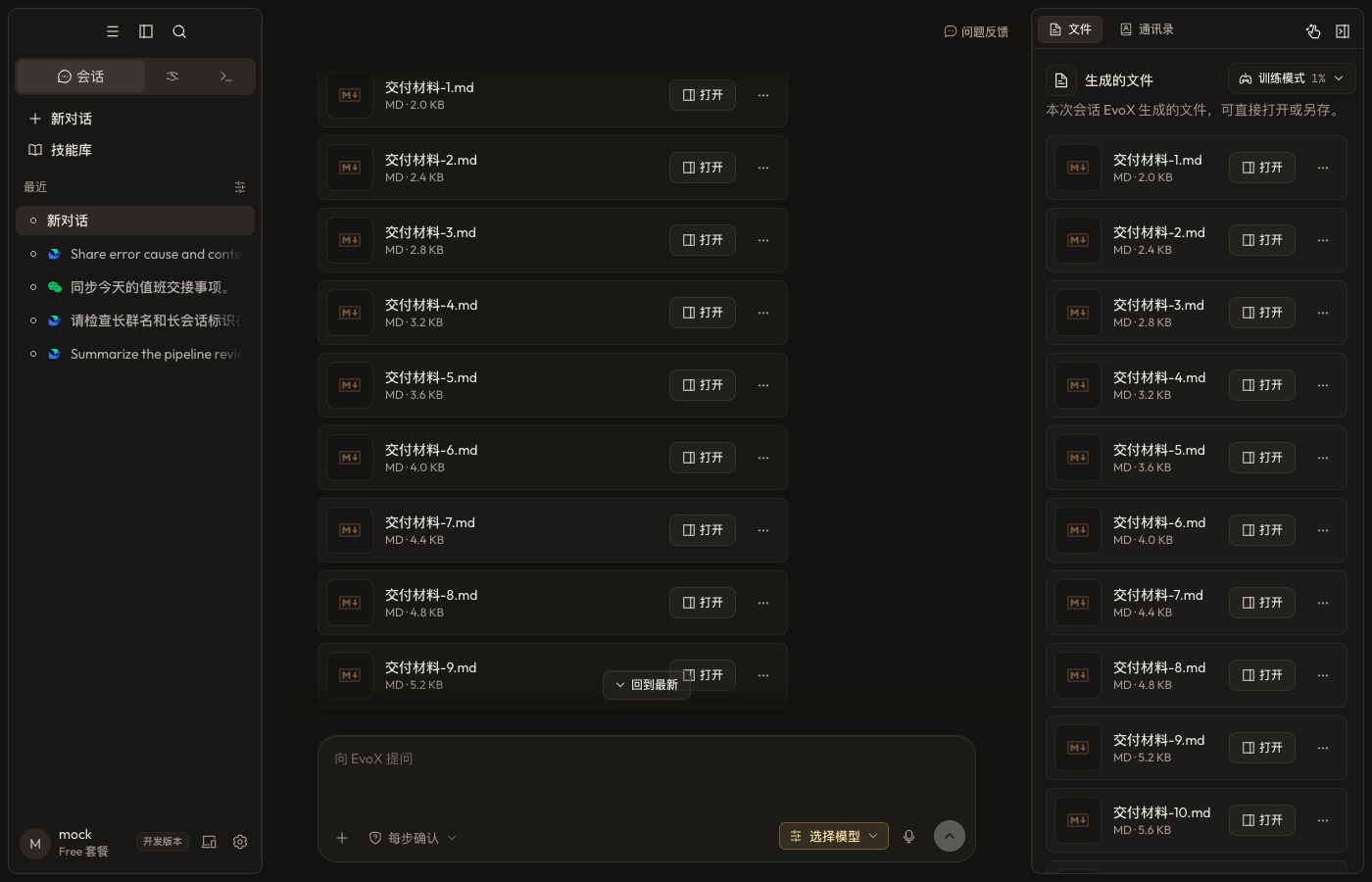
EvoX can produce documents, presentations, spreadsheets, PDFs, images, and other outputs according to available tools. Select the file card or link in the task to open its preview; supported HTML previews can switch between rendered and source content.
Check the filename, saved path, and active version. Use the file’s download or export control when available; otherwise confirm its local location and retrieve it there. A filename mentioned in a reply does not prove that the file exists.
Revise an existing file
Name the target file, requested change, and content that must remain stable. Specify whether to edit in place or save another version. Confirm the path and active version first; overwriting the original is not a system guarantee. Re-render office files and PDFs before export to check pagination, tables, fonts, and images.
Versions and provenance
The artifact list only contains real generated files or explicit preview-tool results; assistant prose alone does not manufacture a file. Verify the active version before continuing edits.
Watch the data-cleaning workflow example
File safety
List the impact before bulk moves, overwrites, or deletion. Do not treat project membership as whole-disk access. Archives, scripts, and web downloads are untrusted input. Before handoff, verify that the file opens, its format and location are correct, and no secrets or restricted data are included.
EvoX Docs · Features · Capabilities