Deterministic Replay LLM Industry Standards Protocols
Hi, I’m Lena. I’ve been spending more time watching AI agents do longer, messier work: reading files, calling tools, changing state, producing artifacts, and sometimes turning a successful run into something the system may reuse later. I paused here, because the interesting question is not whether an LLM can say the exact same words twice. The better question is whether a team can look back at an agent run and understand what actually happened.
That is where deterministic replay starts to matter. In this article, I’m treating deterministic replay LLM industry standards protocols as an audit and verification problem, not a magic repeat button. We’ll look at what a replayable run needs to capture, which public standards can help, where interoperability is still missing, and why reusable agent experience should be tied to evidence before it gets trusted again.
What Deterministic Replay Means for LLM Agents
Replayable State, Tool Calls, and Artifacts
A replayable agent run needs a record of the state before, during, and after execution. That includes the original user request, system instructions, retrieved context, memory state, tool permissions, model version, tool call payloads, tool responses, generated files, intermediate artifacts, and final output.
The key word here is “state.” If the agent edited a file, queried a database, called a browser tool, or used a stored workflow memory, the replay record should show that transition. Without state transitions, the record becomes a transcript. Transcripts are useful, but they are not enough for reproducible agent runs.
Repeatable Behavior Is Not Identical Text
I want to be careful here. Replay should not be sold as identical wording across every run. LLM systems can be affected by sampling settings, hosted model updates, retrieval changes, tool latency, and external API behavior. A strong replay system should instead support behavioral comparison: did the same inputs and frozen dependencies produce the same tool plan, the same file changes, the same validation result, and the same reusable experience candidate?
For engineering teams, that is the practical unit of trust. The exact paragraph may vary. The audited path should not be mysterious.
What a Replay System Must Capture
Inputs, Versions, Environments, and State Transitions
A serious replay record starts before the first model call. It should capture prompt layers, policy constraints, memory snapshots, skill versions, dependency hashes, model identifiers, sampling parameters, environment variables that matter, and the sandbox or runtime profile used for execution.
The record also needs a timeline. Each event should say what happened, when it happened, which agent or tool caused it, what state it used, and what state it produced. This is where deterministic replay standards for LLM agent platforms become less about AI vocabulary and more about system engineering.
Tool Results, Checkpoints, and Validation Evidence
Tool calls deserve special treatment because they are where many agent failures hide. A replay system should store the request payload, normalized response, error body, retry behavior, timeout, permission scope, and any redacted fields. When tool data cannot be stored directly, the system should at least store a signed reference, schema version, hash, and retention policy.
Checkpoints matter too. A long agent run should not become one giant blob. It should have review points: plan accepted, tool output verified, artifact generated, test passed, human approved, experience candidate promoted. If the run later becomes reusable agent knowledge, the replay record should show the validation evidence that made reuse acceptable.
Standards and Protocols Around Replay
Audit Logs, Provenance, and Event Schemas
There is no single accepted “agent replay protocol” that all LLM agent platforms implement today. What exists is a set of adjacent standards and practices that teams can borrow from. Provenance work is one layer. The W3C PROV model gives useful vocabulary for entities, activities, agents, derivations, and responsibility. It was not designed specifically for LLM agents, but its mental model fits replay records surprisingly well.
The event structure is another layer. The CloudEvents specification is useful when agent platforms need portable event envelopes across queues, logs, webhooks, and workflow engines. An agent event still needs domain fields, but a common envelope helps avoid every team inventing another incompatible timestamp-and-payload format.
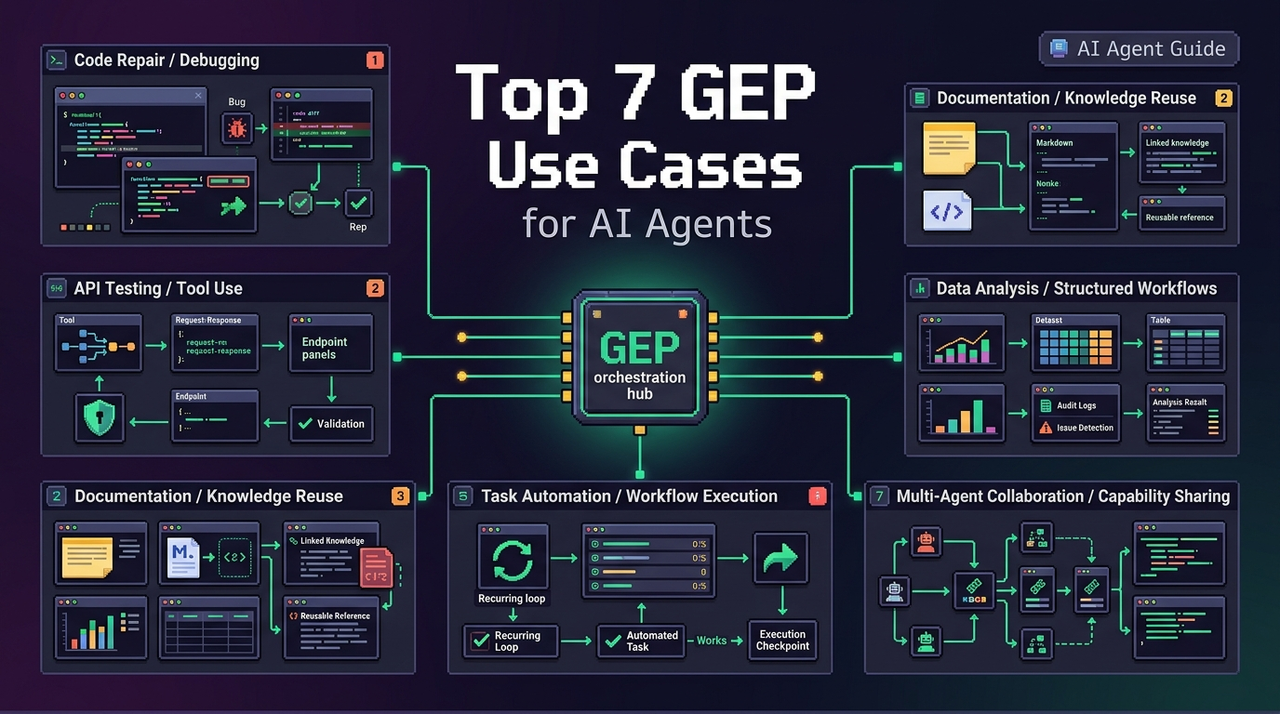
For teams thinking about reusable experience rather than logs alone, it helps to place EvoMap Research next to the GEP concept page in this part of the article. The important bridge is simple: a replay record can explain why an experience asset was trusted, promoted, rejected, or revoked.
Where Interoperability Is Still Missing
The missing layer is a complete, broadly adopted agent-specific replay semantics layer. Current standards cover some agent and tool semantics, but do not yet define a shared vocabulary across all of “tool intent,” “memory read,” “policy gate,” “human approval,” “validation pass,” or “experience reuse candidate.”
That gap matters. Without shared semantics, one platform’s immutable audit logs may not be portable to another platform’s debugger, compliance review, or procurement audit. Teams can export JSON, but the meaning still needs mapping. This is why I would avoid calling any one internal schema an industry standard too early. Right now, a practical approach today is to build replay systems by combining observability, provenance, event sourcing, and AI governance practices.
A Reference Architecture for Replayable Agent Runs
Event Sourcing and Immutable Run Records
A practical replay architecture can start with event sourcing. The agent does not simply overwrite its current state. It appends events: run created, context loaded, model call requested, tool call issued, tool result received, artifact written, validation executed, review completed, memory updated, experience proposed.
Each event should be immutable after write, with corrections added as new events rather than silent edits. This gives teams a chain they can inspect later. It also makes partial replay possible. You can replay only the planning phase, only tool execution, or only the validation gate.
The running record should connect four stores: the event log, the artifact store, the state snapshot store, and the validation evidence store. The Agent Workflow Memory page belongs naturally here, because workflow memory should not be treated as a vague “memory” feature. It should be tied to the running evidence that made the memory reusable.
Validation Gates Before Experience Reuse
Replay becomes more important when agent runs feed future behavior. If a successful run becomes a reusable capsule, skill, workflow, or strategy, the platform needs a promotion gate. That gate should check whether the run solved the right task, whether tool outputs were verified, whether artifacts passed tests, whether sensitive data was excluded, and whether the experience is narrow enough to reuse safely.
This is the quiet part people skip. Reuse without replay is risky. The system may remember a shortcut without remembering the conditions that made the shortcut valid.
Limits and Trade-Offs
Stochastic Models, External Systems, and Storage Costs
Even a well-designed replay system has limits. Hosted models change. APIs return different data. Browsers render new pages. Permissions expire. A run that touched external systems may be replayable as evidence but not executable in the same world state.
There is also cost. Full replay records can be large: prompts, retrieved context, tool payloads, screenshots, artifacts, traces, and validation logs add up quickly. Teams need retention tiers. Critical regulated workflows may need longer records. Low-risk experiments may only need hashes and summaries.
For governance framing, the NIST Generative AI Profile is a safer source than vendor claims because it treats generative AI risk as a lifecycle problem, not a single model setting. This is not legal advice. Retention, deletion, residency, and user rights should be checked against the applicable jurisdiction and the current policies of every platform involved.
FAQ
How Long Should Teams Retain Replay Records?
There is no universal answer. Teams usually need different retention periods for debugging, security review, customer disputes, regulated workflows, and reusable experience assets. The safer design is policy-based retention by task class, not one default for every run.
Who Owns Replay Data Created by Third-Party Agents?
Ownership depends on contracts, data processing terms, user agreements, and local law. From an engineering view, the replay system should record which agent, model provider, tool provider, and user account contributed data. From a legal view, get counsel before treating third-party agent traces as reusable internal assets.
Can Replay Records Support Insurance or Procurement Reviews?
They can help, especially when they show permissions, controls, validation, and incident response evidence. But a replay log alone is not a certification. Procurement teams usually want policies, access controls, retention rules, deletion workflows, and proof that the system behaves consistently under review.
Can Replay Data Cross Legal Storage Jurisdictions?
Sometimes, but teams should not assume it. Replay records may contain prompts, files, personal data, business secrets, tool outputs, and derived artifacts. Storage region, subprocessors, model providers, and cross-border transfer rules all matter. Check the applicable region before publishing or sharing replay data.
How Should Replay Records Handle User Deletion Requests?
The system should separate raw user data, derived artifacts, hashes, audit metadata, and reusable experience assets. Deleting everything may break audit integrity; keeping everything may violate user rights or platform policy. A good design supports redaction, tombstones, scoped deletion, and evidence that a deletion request was processed.
Replay is not finished as an industry category. That is the honest place to leave it. But the direction is already visible: agent platforms that want reusable experience need more than memory. They need records strong enough to explain why that experience should be trusted next time.
Previous Posts:
- If you want to understand the execution layer behind replayable state transitions, Agent Hooks and AI Execution Chains looks at how agent actions can be captured and connected across a longer run.
- For the memory side of reproducible agent workflows, Agent Workflow Memory Explained explores why reusable workflow experience needs more structure than simply saving conversation history.
- To place deterministic replay inside the wider runtime architecture, OpenHarness and GEP Agent Stack Layers explains how execution infrastructure and reusable experience sit at different layers of the agent stack.
- If a replayed run eventually becomes something an agent can reuse, Agent Skills vs GEP Assets explains the difference between reusable instructions and validated experience assets that carry stronger evidence about how they were produced.