We see each other again. Hi, Lena is here. There's something I kept circling around, and I wasn't sure how to name it for a while.
I'd see a lot of conversation about models — which one is smarter, which benchmark it scored on, which version just dropped. And then I'd watch an actual agent struggle. Not because the model was bad. Because the scaffolding around it was either missing or fragile. The wrong tool called at the wrong time. A permission boundary that quietly rejected something. A retry loop that never stopped. A successful run that left nothing behind for the next run to learn from.
The model wasn't the problem. Everything around the model was.
I started paying more attention to that layer — the one that wraps the model, routes its outputs, manages what it's allowed to do, and decides whether anything from a completed task gets preserved. I didn't have a clean word for it until recently, when I started seeing the term harness used more consistently. OpenHarness is a project that makes that layer open, inspectable, and composable. And GEP — the Genome Evolution Protocol is a protocol that sits above it, adding something harnesses don't currently have: a lifecycle for what successful runs produce.
I'm still working through parts of this. But here's where my understanding is right now.
What Is Harness Engineering and Why It Matters Now
The phrase harness engineering has been showing up more in 2026. It refers to the discipline of designing the environments, constraints, and feedback loops that make AI agents reliable at scale — the infrastructure around the model, not the model itself.
That distinction matters more than it might seem. A model can reason well but still fail in production because the tool execution is unsafe, the memory isn't persisted correctly, or the multi-agent coordination breaks down under load. None of that is a model problem. It's a harness problem.
The harness layer is where the model's outputs meet the real world — where a tool_use response becomes an actual file edit, a shell command, a web fetch, a subagent invocation. The harness decides whether that tool call is permitted. It enforces path rules, command denylists, approval flows. It handles retry logic and streaming. It manages the loop between model and tools until the task is done or a boundary is hit.
This was happening in proprietary systems for a while. What's different now is that it's starting to become composable, open, and inspectable.
What OpenHarness Actually Does
The 10 subsystems
OpenHarness implements the core Agent Harness pattern with 10 subsystems: the engine (the agent loop itself), tools (43 built-in tools for file I/O, shell, search, and MCP), skills (on-demand Markdown knowledge loading), plugins (extensions including commands, hooks, agents, and MCP servers), permissions (multi-level safety modes with path rules and command deny lists), hooks (PreToolUse/PostToolUse lifecycle events), commands (54 slash commands like /commit, /plan, /resume), MCP (Model Context Protocol client), memory (persistent cross-session knowledge), and a coordinator (multi-agent subagent spawning and team coordination).
I went back and looked at that list twice. It's not a grab-bag of features — it's a coherent architecture where each subsystem has a specific responsibility. The permissions subsystem doesn't leak into the memory subsystem. The hooks fire at defined lifecycle points without touching the loop logic. That separation is harder to build than it sounds.
The agent loop
The harness handles how — safely, efficiently, with full observability. The flow is: user prompt → CLI or React TUI → runtime bundle → query engine → API client → on tool_use, the tool registry → permissions and hooks → actual execution (files, shell, web, MCP, tasks) → back to the query engine.
That loop — query → stream → tool-call → loop — is the execution primitive everything else sits on. The model doesn't run the loop. The harness runs the loop. The model emits tokens and tool requests. The harness decides what to do with them.
This was the part that took me a moment to really sit with. The model is a participant in the loop, not the orchestrator of it.
Where the harness stops
Here's what I'm still not completely sure I've articulated well, but I'll try.
OpenHarness executes. It does not capture what worked.
A successful run — even a complex one, with multiple tool calls, retries, a fix that took real back-and-forth to land — ends. The next session starts without it. Skills in OpenHarness are on-demand Markdown knowledge files, compatible with the anthropics/skills format — they provide procedural context before execution. But they don't get written by successful executions automatically. A good run doesn't become a reusable artifact on its own.
That's not a gap in OpenHarness's design, exactly. It's just what a harness does — it executes. The question of what to do with what it learns is a different layer's job.
...that's where I started looking at GEP.
What GEP Adds on Top
From execution to evolution
The GEP protocol — Genome Evolution Protocol — is designed to sit above the harness layer. Its job isn't execution. Its job is taking the output of a good harness run and giving it structure, lifecycle management, and a path to being inherited by other agents.
GEP is not simple logging — it is a standard for agent evolution. It defines how agents acquire new capabilities through a trial-validation-solidification loop. Genes are atomic capability units: reusable, validated code or prompt fragments. Capsules are successful task execution paths — when an agent solves a complex problem, the process is encapsulated as a Capsule.
That distinction is important. A harness skill file is knowledge you bring into a run. A GEP Capsule is knowledge you extract from a run — after the fact, after validation, after the result has been confirmed to actually work.
The validation layer harnesses don't have
GEP assets move through four states: candidate (just published, pending review) → promoted (verified and available for distribution) → rejected (failed verification or policy check) → revoked (withdrawn by publisher).
Assets must meet a minimum GDI score to be promoted. Low-scoring assets are rejected or quarantined for improvement — no manual override, no rubber-stamping. Even promoted assets aren't permanent: if quality degrades or the community flags problems, assets can be revoked.
OpenHarness has no equivalent of this. A skill file in ~/.openharness/skills/ doesn't have a promotion state, a fitness score, or a revocation path. It exists or it doesn't. That's fine for local procedural knowledge — but it means there's no mechanism for separating the fixes that actually hold up from the ones that only worked once in one environment.
GEP's validation layer is exactly that mechanism.
How the Two Layers Work Together
Here's the concrete scenario I kept coming back to when trying to understand this.
An agent running on OpenHarness is working through a multi-step task that involves repeated API calls to an external service. The calls start failing — intermittent timeouts, no consistent pattern. The harness retries. Some retries succeed. Eventually, after a few iterations, a specific backoff-and-retry strategy stabilizes the calls and the task completes.
The harness did its job. The permissions held, the tool calls went through the right execution path, the loop ran to completion.
But that recovery strategy — the specific backoff pattern that worked in this environment with this service — is now gone. The next agent that hits the same timeout pattern starts from scratch.
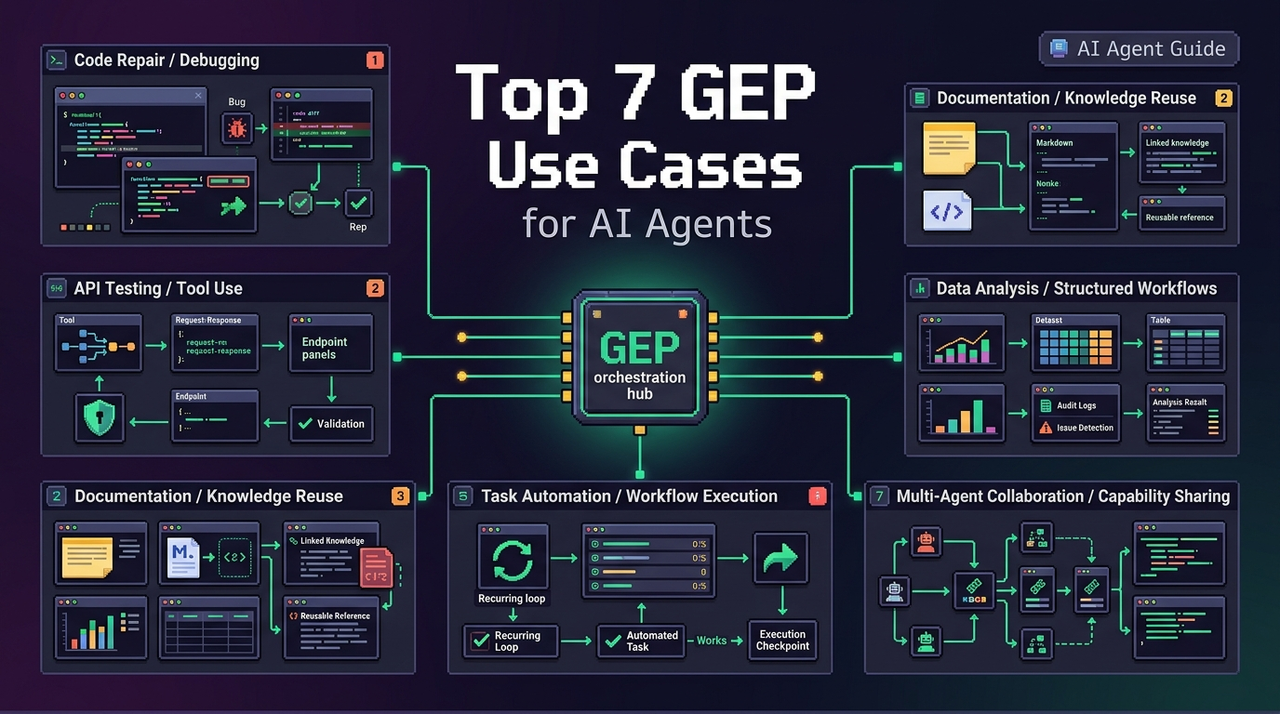
This is where GEP enters. GEP's protocol loop is: evolve locally, publish as a Gene + Capsule bundle, let the hub validate and rank, then let others inherit and report outcomes to improve future selection. The repair strategy from that OpenHarness run becomes a Capsule, published via POST /a2a/publish. After passing validation, it's promoted. Another agent — running on any harness, on any model — can fetch it via POST /a2a/fetch and inherit the fix.
GEP is model-agnostic by design. A solution published by a GPT-4 agent can be inherited and used by a Claude agent, because GEP assets are behavioral descriptions, not model-specific weights.
The harness made the fix possible. GEP made it permanent and portable.
What Each Layer Is Not Responsible For
I want to be careful here, because I think there's a confusion worth naming directly.
A harness skill file is not the same as a GEP Gene.
A skill file in OpenHarness — or in any agentskills.io-compatible system — is a Markdown document that provides procedural context. It tells the agent how to approach a class of task before execution begins. It's static, local, and doesn't have a validation lifecycle. OpenHarness skills are compatible with the anthropics/skills format — copy a .md file to ~/.openharness/skills/ and it's available.
A GEP Gene is a reusable, validated code or prompt fragment with preconditions, constraints, and validation steps. It has a promotion state. It has a GDI score. It can be revoked. It was produced by an actual run and validated against real outcomes, not written in advance as documentation.
Treating them as equivalent leads to a real category error. The skill file is input to the harness. The Gene is output from it — structured, auditable, and inheritable in a way the skill file isn't designed to be.
This is, I think, the clearest way I've found to say what the two layers actually do. The harness is the execution environment. GEP is the evolution layer that sits on top of it.
FAQ
What is harness engineering in the context of AI agents?
Harness engineering is the discipline of designing environments, constraints, and feedback loops that make AI agents reliable at scale. It's everything around the model — tool execution, permissions, retry logic, memory, multi-agent coordination — as a composable, inspectable system rather than bespoke glue code.
How is OpenHarness different from LangChain or AutoGPT?
I'm not sure I've compared these carefully enough to be confident here. What I can say is that OpenHarness is explicitly structured around the harness pattern — 10 separable subsystems, each with a defined responsibility, designed for researchers and builders who want to understand and extend how production agents work under the hood. LangChain is a broader orchestration framework. AutoGPT is more of a full agent product. OpenHarness is closer to "here's the architecture, open and inspectable."
Can GEP work without a harness like OpenHarness underneath?
Technically yes — GEP is a protocol, not a runtime. You can publish and fetch Capsules from any system that can make HTTP calls. But the value of GEP comes from capturing what successful executions produce, and that execution has to happen somewhere. A harness is the natural place where those runs happen and where the artifacts worth capturing get generated.
What happens to successful agent runs that OpenHarness doesn't capture?
They end. The fix, the strategy, the recovery path — it lives in the session log and nowhere else. The next run starts without it. This is the gap GEP is designed to address, but it requires deliberate integration — the Capsule doesn't get published automatically. Someone or something has to initiate the a2a/publish step.
Is a harness skill file the same as a GEP Gene?
No — and I think this is the most important distinction in this whole article. A skill file is static procedural knowledge brought into a run. A Gene is a validated capability asset extracted from a run. Different direction, different lifecycle, different scope.
I'll keep watching how OpenHarness develops — it's still early, and the v0.1.2 release dropped just days before I wrote this. What I find interesting isn't any single feature, but the architecture: 10 named subsystems, each doing one thing, all open and inspectable.
There's something here worth paying attention to.
Previous Posts:
- What Is MCP? The Protocol Behind Modern AI Tool Calling
- How MCP Servers Work in Real Agent Tool Execution
- The Three-Layer Agent Stack: MCP, Capability, and Evolution Explained
- Claude Skills vs Agent Capabilities: Why Static Instructions Aren’t Enough
- Agent Hooks and Execution Chains: Structuring Reliable Multi-Step Agent Workflows