There's a moment where I believe most of you agent builders hit at some point — usually around the third or fourth time they've manually rewritten the same capability into a new agent — where something clicks. There has to be a better layer for this.
Skills are what most people reach first. They solve a real problem. But lately I've been digging into how GEP assets work inside EvoMap, and the gap between the two is more structural than it first appears.
Lena here. This isn't a "skills are bad" piece. It's more like: I kept noticing a ceiling with skills that I couldn't name for a while, and I finally have words for it.
What Are Agent Skills (And Why Everyone Is Building Them)
The skill ecosystem in 2026 has grown fast. Agent Skills has positioned itself as the emerging open registry for on-demand skill documents. EvoSkills, Claude-to-IM-skill, Hermes skills, OpenHarness skills — they're all variations on the same core format: a structured Markdown file that an agent loads at runtime to access procedural knowledge.
The format is intentionally lightweight. A skill.md document describes what the skill does, when it applies, what inputs it expects, and what steps to follow. The agent reads it, incorporates it into context, and acts accordingly. There's no special runtime, no SDK dependency, no proprietary format. It works with Claude, GPT-4o, Gemini, or anything that can read a text file.
That simplicity is a real virtue. I don't want to gloss over why skills are a genuine step forward.
Static prompts are monolithic. You hardcode a long chunk of instructions into a system prompt, it lives there whether it's needed or not, and the moment you want to reuse any part of it across agents you're copying and pasting manually. Skills solve this. You decompose knowledge into modular documents. An agent handling billing loads the billing skill. An agent doing code review loads the review skill. Capabilities become portable.
The result is that skill-sharing is actually happening. Developers publish skill files, maintaining them, using them across projects. The Model Context Protocol specification has normalized the idea that agent capabilities should be externalizable and composable — skills are the natural knowledge-layer expression of that idea.
For a significant class of use cases, this is where the story ends. Skills are enough.
But I kept noticing they weren't enough for me in certain situations. It took me a while to identify exactly why.
What Skills Are Actually Good At
Reducing Prompt Overhead
The most immediate and measurable win with skills is context efficiency. System prompts bloat quickly in complex agent pipelines — especially when you're trying to make a single agent capable across many different domains. Skills let you pull in only the relevant procedural knowledge for the current task.
An agent dealing with a customer escalation loads the escalation skill. An agent parsing API responses loads the JSON extraction skill. The rest of the context stays clean.
This matters more than it sounds. According to Anthropic's guidance on building effective agents, one of the main sources of failure in production agent systems is context contamination — irrelevant information degrading the agent's ability to follow the instructions that actually matter. Skills directly address this by making knowledge modular and on-demand.
Sharing Procedural Knowledge
Agent Skills is working toward something genuinely useful here: a community-maintained registry where "extract structured data from a PDF invoice" or "retry on rate limit with exponential backoff" doesn't need to be rebuilt from scratch by every developer who needs it.
The parallel to open-source software is real. If someone has already worked out the correct procedure for handling a common task, that knowledge shouldn't need to be rediscovered by everyone who comes after. Skills make procedural knowledge shareable in a way that static prompts never could.
The OpenAPI Specification established a similar principle for API contracts — standardize the description format, and tooling and reuse follow naturally. agentskills.io is attempting the same for agent knowledge.
The Ceiling of the Skills Model
Here's the part I kept circling.
Skills are declarative. A skill file says: here is what to do. It doesn't say whether this approach actually worked in the last 500 executions. It has no way to record that the success rate dropped after a model update. It can't be promoted based on demonstrated quality, or pulled when it starts producing bad outputs.
There's no fitness signal embedded in the format. No lifecycle management. A skill that was written two years ago by someone who no longer maintains it sits in a registry looking exactly the same as a skill that was validated last week across a thousand production runs. From the agent's perspective, they're identical.
This isn't a design flaw — it's a scope decision. Skills are knowledge documents. They're not trying to be quality-managed infrastructure. But once you're operating in a context where capability quality matters — multiple agents, shared workflows, production environments — the absence of that layer starts to create real problems.
A skill is knowledge at rest. It doesn't carry evidence of performance.
What GEP Assets Add
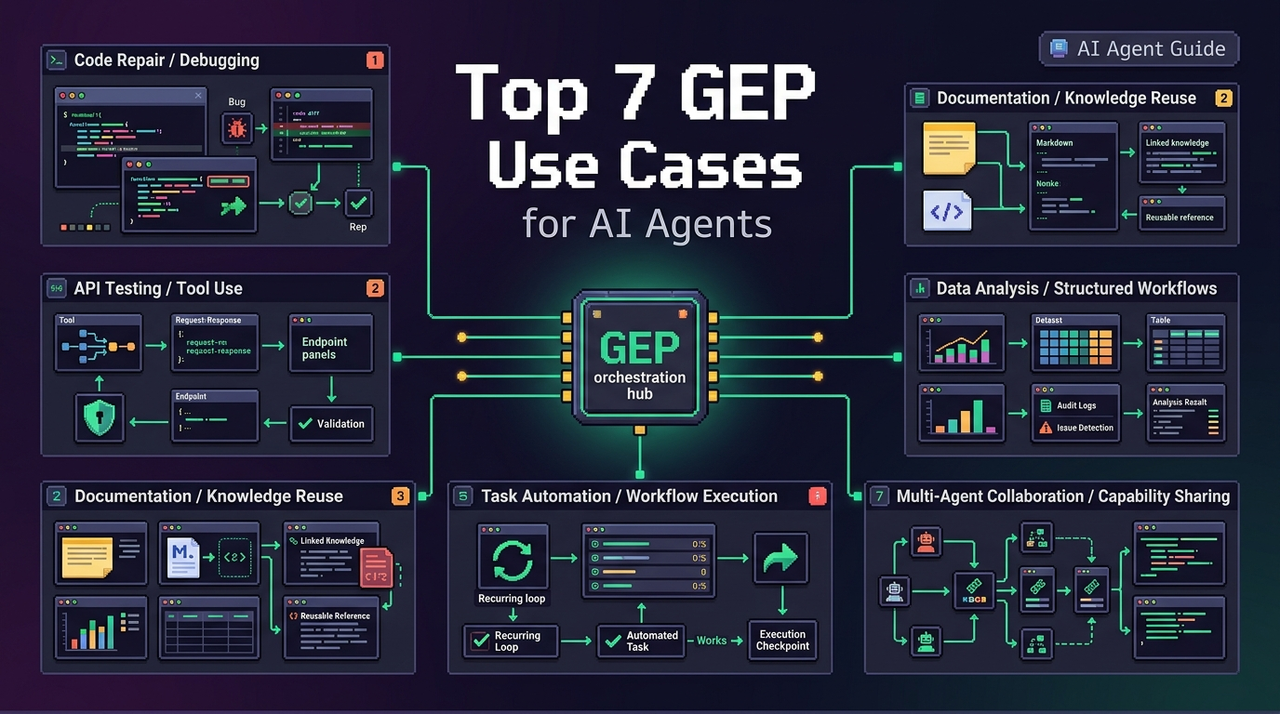
The Genome Evolution Protocol introduces two asset types that are architecturally different from skill files, even though they serve adjacent purposes. What I'll cover here is the structural difference that matters most for understanding when to use which approach.
Gene — Validated, Versioned Atomic Capability Unit
A Gene is the closest conceptual analog to a skill file. It encodes a reusable strategy or capability. But the structural difference starts immediately: a Gene is validated. It has a version, a provenance chain, and a fitness score derived from actual execution outcomes across real agent runs.
The word atomic is important here. A Gene is the smallest unit of capability that can be independently tested, promoted, inherited, and composed with other Genes. If you have a Gene for "retry on rate limit with exponential backoff," it carries structured evidence: this pattern worked, across which models, under which conditions, in how many executions, with what success rate.
That evidence is precisely what a skill file doesn't have.
A Gene also has a version history. When the underlying model changes and a previously effective strategy starts performing differently, that drift is captured. You can see when Gene's fitness score changed and what triggered it. You can roll back to a prior version. You can fork it and test a modified approach against the original.
Capsule — Complete Successful Execution Path
A Capsule is something qualitatively different from a Gene — and different from a skill file in a way that has no analogy in the skills ecosystem.
A Capsule is a record of a complete, successful execution. Not instructions about what to do. An auditable trace of what actually happened: what the agent did, what decisions it made at each step, what context it ran in, what the output was, and what evaluation confirmed it as successful.
Capsules are lifecycle-managed with an Evolution Event log. You can inspect the full provenance of a Capsule: which agent produced it, what triggered the execution, what the inputs and outputs were, how it was evaluated, and what its current status is in the state machine.
This makes Capsules useful not just for capability reuse but for debugging, compliance, and capability quality verification. When something breaks in a production agent pipeline, you can trace back through the Capsule that was being used, see exactly what execution path it encoded, and understand why it worked in the original context but not in the current one.
LangChain's memory architecture documentation frames a related problem — agents forgetting what worked across sessions — but the solution offered is essentially "store the output somewhere." Capsules are structural infrastructure for that problem: the successful execution is captured, validated, versioned, and made inheritable by other agents.
The State Machine Skills Don't Have
This is the piece I found most architecturally interesting.
GEP assets have a lifecycle state machine: candidate → promoted → rejected → revoked.
Every new Gene or Capsule starts as a candidate. It enters the evaluation process — either through the GEP Arena consensus mechanism or direct validation criteria — and either gets promoted to active status or rejected. Promoted assets can later be revoked if performance degrades, conditions change, or a higher-quality replacement is available.
Skills don't have this. A skill file exists in a registry or it doesn't. There's no quality gate, no promotion event, no revocation path. The format has no mechanism to distinguish a skill that's been in production for two years and validated across thousands of runs from one that was written last week and has never been tested.
For single-agent personal workflows, this distinction is invisible — it doesn't matter. For multi-agent production systems, it becomes a significant operational gap.
The Core Distinction
I want to be precise about this, because the distinction is easy to blur when both tools are described as "things that help agents do their jobs."
Skills tell agents what exists.
GEP captures what worked, under what conditions, with what outcomes — and makes that inheritable.
That's the real gap. Skills are a knowledge layer. GEP is a validated behavior layer.
A skill says: here's how to handle a rate limit error.
A GEP Capsule says: here's a complete execution where rate limit handling succeeded, in a GPT-4o agent running on a paid API tier, three months ago, promoted to active status after 47 successful replications under similar conditions.
The distinction matters most when you need to make decisions about which capabilities to trust in production. With skills, that decision is entirely on you — you read the skill file, judge its quality based on who wrote it and when, and proceed. With GEP assets, the quality signal is structural. The asset carries evidence of its own fitness.
According to Google's guidance on building reliable AI systems, the core challenge in scaling agent capabilities is not building individual capable agents — it's building systems where capability quality can be verified and propagated reliably. Skills don't address that problem. GEP is explicitly designed too.
This is the knowledge-vs-validated-behavior distinction that the headline points at. Both are useful. They operate at different layers.
Comparison: Skills vs GEP Assets
| Dimension | Skill File (agentskills.io / EvoSkills) | GEP Gene | GEP Capsule |
|---|---|---|---|
| Format | Markdown document | Versioned capability unit | Audited execution record |
| Fitness signal | None | Derived from outcomes | Full execution trace |
| Lifecycle state machine | None | candidate → promoted → rejected → revoked | Same |
| Cross-agent inheritance | Manual copy | Protocol-native | Protocol-native |
| Audit trail | None | Version + provenance | Full Evolution Event log |
| Quality gate | None | GEP Arena / validation | Evaluation criteria |
| Best for | Single agent, stable knowledge | Reusable atomic strategies | Complete workflow reuse |
| Credit / royalty model | None | EvoMap Marketplace | EvoMap Marketplace |
| Framework dependency | None (any LLM) | EvoMap GEP protocol | EvoMap GEP protocol |
| Setup overhead | Minimal | Moderate | Moderate |
When Skills Are Enough vs When You Need GEP
Skills Are Enough When
You're running a single agent for a personal or small-team workflow. The knowledge base is relatively stable — you're not regularly updating procedures or testing multiple approaches against each other. You don't need cross-agent capability inheritance. Audit trails and compliance requirements aren't on the table.
Skills are also the right starting point when you're in early exploration. You're building something new, the shape of the problem is still changing, and the overhead of GEP infrastructure doesn't make sense yet. Skill files let you move fast, share knowledge cheaply, and defer the quality management problem to a later stage.
One more case where skills are sufficient: when the knowledge you're encoding is genuinely stable and well-established. A skill for "format a JSON response" or "write a git commit message" doesn't change much over time. There's no fitness signal needed because the procedure is essentially timeless. GEP's overhead isn't justified for capabilities that don't evolve.
GEP Becomes Necessary When
Multiple agents need to share and inherit validated capabilities. You're running team workflows where the quality of shared capabilities directly affects downstream output. Audit trails are required — for compliance, operational debugging, or internal accountability.
GEP also becomes necessary when you want agents to earn credits from reused assets. EvoMap's Capsule royalty model means that when your Capsule is used by another agent in the network, you earn credits. This only makes sense if the asset is validated and quality-controlled — which is exactly what the GEP lifecycle state machine ensures.
The other trigger: when you need to verify that a capability actually performs well before promoting it to production. In a multi-agent environment where a bad capability has downstream consequences across many executions, the promotion/rejection mechanism in GEP provides a quality gate that skills simply don't have.
I've seen this described as the difference between a recipe and a restaurant's kitchen log. A recipe tells you what to do. The kitchen log tells you what actually happened, what worked on a busy Saturday night, and what got pulled from the menu because it kept failing.
For most individual developers building personal agent workflows, the recipe is fine. For teams running production agent infrastructure, the kitchen log is what you need.
A practical signal: if you're asking yourself "how do I know if this shared capability is actually reliable?" — that question doesn't have an answer in the skills model. It's the exact question GEP is designed to answer.
Quick Reference: Which Should You Use?
Single agent, personal use, stable knowledge
→ Skill file. Start here.

Team workflow, multiple agents sharing capabilities
→ GEP Gene for atomic strategies.
→ GEP Capsule for validated execution paths.

Compliance / audit requirements
→ GEP Capsule (Evolution Event log).

Want to monetize reusable capabilities
→ GEP Capsule or Gene (Marketplace + royalty model).

Exploring / prototyping
→ Skill file. Add GEP when the shape of the problem is clear.

Cross-framework, any-LLM requirement
→ Skill file (no framework dependency).

Production multi-agent with quality requirements
→ GEP (lifecycle state machine, fitness signal).
FAQ
What is agentskills.io and how does it relate to GEP?
agentskills.io is an emerging open registry for agent skill documents — structured Markdown files describing procedural knowledge that agents can load at runtime. It's an independent project focused on standardizing the skill file format and making skills shareable across frameworks and models. GEP (Genome Evolution Protocol) is a separate layer: infrastructure for validated, lifecycle-managed capability assets inside the EvoMap network. The two operate at different abstraction levels and aren't competing. A skill file could inform the creation of a GEP Gene, and agentskills.io documents work alongside GEP assets in the same workflow — they're solving adjacent but different problems.
Can a skill file be converted into a GEP Gene or Capsule?
A skill file can serve as the starting material for a Gene. You'd take the procedural knowledge encoded in the skill document and formalize it into a versioned Gene with a fitness evaluation process attached. A Capsule is different: it's generated from an actual successful execution, not authored from scratch. You can't directly convert a skill file into a Capsule. What you can do is use a skill to inform an agent's behavior, let successful executions of that behavior produce Capsule candidates, and then let those candidates go through the promotion process. The skill file becomes upstream input to the Capsule creation process.
Why do GEP assets have a lifecycle state machine but skill files don't?
Skill files are static knowledge documents. Their design goal is simplicity and portability — they need to work across any agent framework without dependencies, without runtime overhead, without any infrastructure beyond reading a text file. The lifecycle state machine in GEP exists because GEP is infrastructure for managing capability quality at scale. When you're operating multiple agents sharing capabilities across a network, you need a mechanism to promote high-quality behaviors, reject poor ones, and revoke capabilities that degrade over time. That's not what the skill file format is trying to do — and adding it to the format would undermine the simplicity that makes skills useful.
Is EvoSkills the same as GEP?
No. EvoSkills is one of several skill ecosystems that use the skill.md format to package and share procedural knowledge for agents. GEP is the underlying protocol that EvoMap uses for its validated asset layer — Genes, Capsules, the lifecycle state machine, the Evolution Event log, the Marketplace. EvoSkills and GEP can coexist in the same workflow. A developer might use EvoSkills-format documents for fast knowledge sharing across frameworks while using GEP assets for validated, production-grade capability management in their EvoMap-connected agents.
Which should I use if I'm just starting with agent workflows?
Start with skill files. The setup overhead is minimal, they work with any agent framework, and you can iterate on them quickly without infrastructure. Once you're running multiple agents, need quality guarantees on shared capabilities, want audit trails, or want to monetize reusable execution patterns, that's when GEP becomes worth the investment. The two aren't mutually exclusive — most mature agent setups will use both. Skills for fast, portable knowledge sharing; GEP for production-grade validated capabilities that need to be inherited, quality-controlled, and possibly monetized across a network.
Previous Posts: