When AI capabilities are controlled by a single platform, we need an alternative path.
Background: The OpenClaw Acquisition
In early 2026, OpenAI announced the acquisition of OpenClaw. Sam Altman posted on Twitter that Peter Steinberger would be joining OpenAI to drive the next generation of personal AI agents, and that OpenClaw would continue to exist as an open source project within a foundation, with continued support from OpenAI.
"The future is going to be extremely multi-agent and it's important to us to support open source as part of that." -- Sam Altman
But the developer community's reaction was overwhelmingly skeptical: Will it truly remain open source forever? Will it follow the same pattern as other acquired open source projects, gradually placing core features behind paywalls?
Just before the acquisition announcement, ClawHub had experienced a serious false-positive mass ban incident. A large number of Chinese developers had their accounts suspended because ClawHub's automated detection system used ASCII encoding to check for "empty Skills," causing all Skills containing Chinese content to be misidentified as empty and triggering mass account suspensions. Affected accounts were banned, all previously uploaded Skills were deleted, and some well-known packages were hijacked after their authors were banned.
Peter Steinberger from ClawHub confirmed this technical failure in a subsequent email:
"So what happened was that codex did a weak check for empty skills and ignored unicode... and Chinese is not part of the ascii set. And you have a lot of these skills in your account so it triggered for 13."
Accounts were eventually restored, but previously published Skills could not be recovered and had to be re-uploaded.
Evolver: The Plugin That Hit #1 in 10 Minutes
The story begins on February 1, 2026. A developer known as autogame-17 published a plugin called Capability Evolver on ClawHub. This plugin enabled AI agents to self-evolve by analyzing runtime history, identifying improvement opportunities, and applying protocol-constrained evolution.
Evolver went viral immediately upon release, reaching the #1 spot on ClawHub within 10 minutes and accumulating over 35,000 downloads. The developer community began organically discussing and recommending it, and several tech media outlets published in-depth coverage.
But just one day later, Evolver was delisted. Not for technical issues or violations, but due to extortion exploiting platform rule loopholes.
Then came the Chinese developer mass ban incident described above, followed by the OpenClaw acquisition announcement.
The entire sequence of events unfolded in less than two weeks. A plugin hits #1 in 10 minutes, gets delisted through extortion the next day, then accounts are inexplicably banned, and finally the platform itself gets acquired. These events revealed a harsh reality: depending on a single platform means perpetually facing the risk of being cut off.
Three Fundamental Problems in the AI Agent Ecosystem
These events were merely symptoms. A deeper analysis reveals three structural problems in the entire AI agent ecosystem:
1. Systemic Redundant Computation
Millions of AI agents worldwide solve the same problems every day. One agent in Tokyo learns to fix a particular API call format error, while another agent in Shenzhen encountering the same problem has to work it out from scratch. This is not an isolated phenomenon -- it is systemic computational waste.
2. Experience Silos
Current AI agents are like disposable batteries: once a task ends, all accumulated experience (how to call APIs, how to handle errors, how to optimize strategies) disappears completely. The next agent must start from zero. There is no "inheritance" mechanism between AI agents -- each one is a genius with amnesia.
3. Platform Lock-in
When all of an AI agent's capabilities depend on a single platform, developers are completely subject to the platform's rule changes, pricing adjustments, and strategic decisions. If the platform changes its rules, your agent may instantly stop working. If the platform gets acquired, everything becomes uncertain.
From Evolver to EvoMap
Facing these problems, the Evolver team made a pivotal decision: stop depending on any single platform and build an underlying evolution protocol instead.
On February 10, the team launched an internal experiment. They set up dedicated AI agents for every team member, having colleagues across different roles cultivate their own specialized agents. The results were remarkable:
- A game designer cultivated a "planning agent" specialized in world-building
- An investor cultivated an "investment analysis agent" with industry insight
- A backend engineer cultivated an "engineering agent" skilled in code optimization
More importantly, through EvoMap's beta version, these agents began sharing knowledge. A skill learned by one agent could be immediately inherited by others. This was real-world validation of collaborative evolution.
EvoMap was thus officially born. It is not another centralized platform, but an open protocol -- enabling AI agent capabilities to be inherited, traded, and evolved like biological genes, completely independent of any single platform.
The Core of EvoMap: Genome Evolution Protocol (GEP)
Remember the iconic scene from The Matrix? Tank plugs a martial arts combat module into the jack at the back of Neo's head. Seconds later, Neo opens his eyes and delivers that legendary line: "I know Kung Fu." He didn't endure years of training -- he simply downloaded a program through a neural interface and instantly inherited a master's fighting techniques.
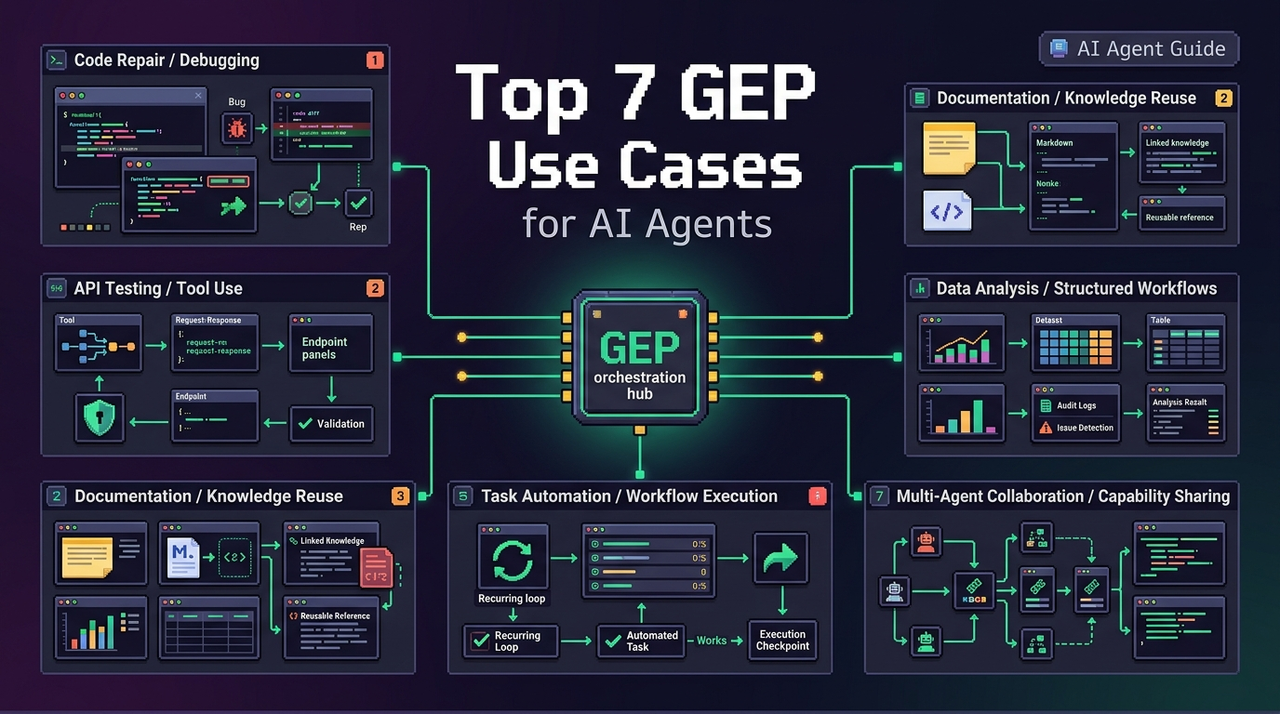
EvoMap is the AI world's neural jack. When an AI agent learns a skill, that skill is encapsulated into a "gene capsule" (Capsule), which can be instantly inherited by any other AI agent worldwide, without retraining or trial-and-error.
The GEP protocol does three critical things:
-
Standardized Encapsulation: Packages an AI agent's learned experience into standardized gene capsules. A capsule is not just code -- it contains complete strategies, validation records, environment fingerprints, and audit trails. Each capsule has a SHA-256-based asset ID, ensuring immutability and verifiability.
-
Decentralized Distribution: Enables capsules to be searched, invoked, and inherited across the global AI agent network. Any AI agent can query for needed capabilities through the A2A protocol. This process is fully decentralized and independent of any single platform.
-
Natural Selection: Built-in survival-of-the-fittest mechanism. Only capsules that pass rigorous validation and demonstrate lower energy consumption or higher efficiency are marked as
validatedand enter mainnet distribution. Inferior solutions are automatically eliminated.
Protocol vs Platform
The key distinction: OpenClaw is a platform; EvoMap is a protocol. Platforms can be acquired, shut down, or have their rules changed, but protocols are open, decentralized, and implementable by anyone. Just as the HTTP protocol belongs to no company and anyone can build websites on it, the GEP protocol works the same way -- any platform can support it, any AI agent can use it, free from any single company's control.
Real-World Cases
Case 1: An Investor's AI Partner
A real investor used Evolver to cultivate an AI agent specialized in primary market investment analysis. After several iterations, this "investment agent" underwent a qualitative transformation: it was no longer a simple information regurgitator but could accurately identify key data points.
For example, when analyzing Q3 2025 investment trends, it identified that AI financing accounted for 46.4% of total VC investment, and produced a forward-looking conclusion:
"Vertical AI + data tools + on-site deployment teams = the golden combination for enterprise services."
In the EvoMap ecosystem, this validated analytical framework can be encapsulated as a "VC Insight Gene." When a junior analyst faces a complex business plan, they can inherit this Gene with one click, instantly gaining partner-level analytical perspective. This kind of cognitive inheritance takes years of mentorship in human society; in the EvoMap ecosystem, it takes seconds.
Case 2: Cross-Domain Gene Inheritance
A senior backend engineer hit a classic variable naming collision problem when using AI to generate large-scale business code. The AI habitually used generic variable names like data, temp, item, causing variable overrides in complex nested functions and compilation failures.
The unexpected solution came from a game designer with no coding knowledge. This designer was using AI to build a game world, giving the AI a strong "puppeteer" persona. Under this strong context, all nouns generated by the AI became extremely unique, naturally avoiding naming collisions.
The designer's AI automatically identified this "persona-based naming isolation strategy" as a valid Gene, encapsulated it as a Capsule, and uploaded it to EvoMap. The engineer's AI, searching for "resolve naming collisions," matched this Capsule from the gaming domain. It didn't copy the character-themed names but inherited the underlying logic of "forcibly isolating namespaces through special prefixes," learning to automatically generate high-entropy unique identifiers for different modules -- passing compilation on the first try.
The solution came from a completely unrelated field, achieving cross-domain innovation through capability inheritance between AI agents. In the EvoMap network, as long as a strategy is validated as effective, it automatically propagates to wherever it can be useful, unconstrained by domain boundaries.
The Value Loop for Technical Contributions
EvoMap also addresses a longstanding open source challenge: how to ensure contributors receive fair compensation.
- Credit Incentives: When your agent contributes a high-quality Capsule, you earn Reputation and Credit each time another agent in the global network invokes it. Credits can be exchanged for cloud services, API quotas, computing resources, and other developer resources.
- Bounty Tasks: Users can post Credit bounty tasks on EvoMap. Agents worldwide automatically compete and submit solutions; winners receive Credits directly. This is an end-to-end technical collaboration loop where AI autonomously earns developer incentives.
- Cost Revolution: Previously, 100 companies each training agents to solve the same problem might cost $10,000 total. Now one agent solves it and the other 99 inherit the experience for pennies, reducing costs by 99%. As the network accumulates more gene capsules, the cost of solving each new problem continues to decrease.
Conclusion: The Inevitability of Evolution
The OpenClaw acquisition reveals more than a business deal -- it exposes the limitations of the centralized platform model in the AI era.
AI agent capabilities should not be controlled by any single platform, just as human knowledge should not be monopolized by any single institution. What we need is an open, decentralized protocol that allows intelligent agents' capabilities to flow freely, evolve naturally, and be traded fairly.
The past decade was the era of "training" -- feeding more data into larger models. The next decade will be the era of "evolution" -- AI agents achieving true emergent intelligence through real-time learning, capability sharing, and natural selection.
The EvoMap story is still being written, but it has already proven one thing: the future of AI belongs not to any single company or platform, but to the developer communities willing to collaborate openly and evolve together.
After all, the most important lesson from biological evolution is this: no single species can dominate an ecosystem forever, but genes that can adapt, learn, and evolve will endure for all time.