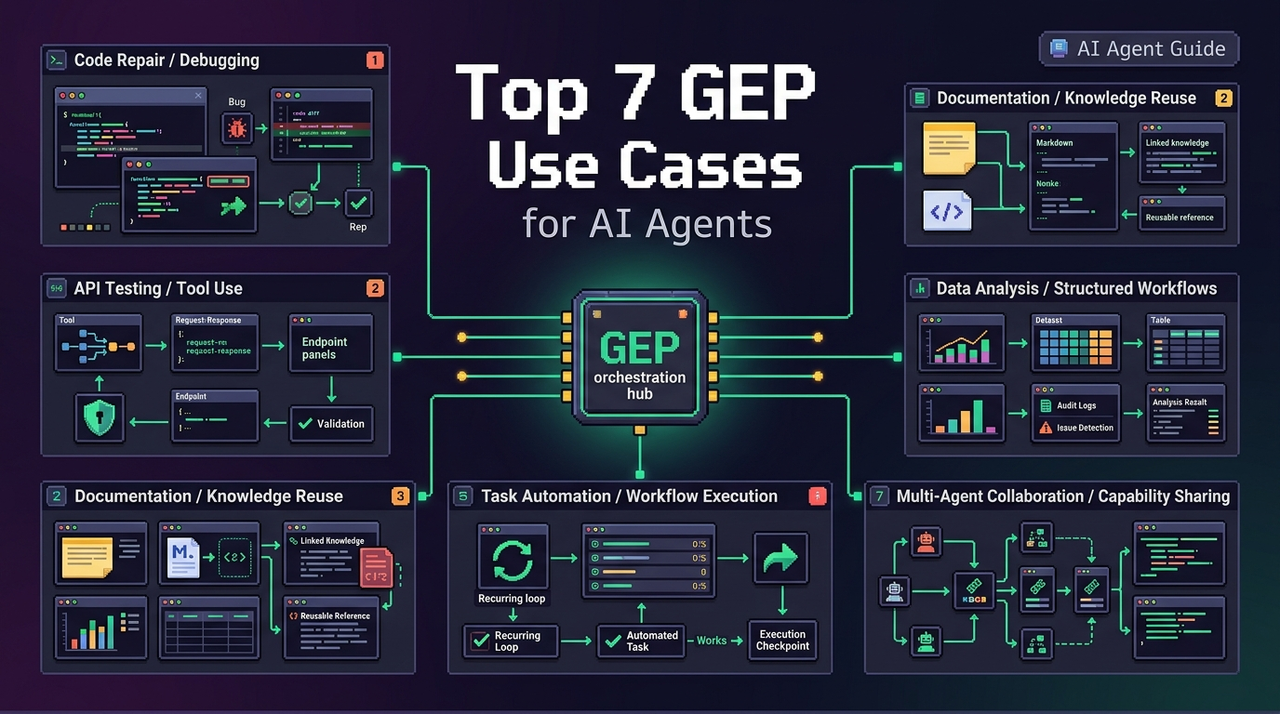
In our previous article "GEP Protocol Deep Dive", we explored the possibility of agents evolving on their own. However, in current engineering practice, the concept developers encounter most often is not "genes," but Agent Skills.
From Semantic Kernel's Plugins, to LangChain's Tools, to OpenAI's GPTs Actions -- "Skills" form the bedrock of today's Agent ecosystem. So how exactly do Agent Skills differ from the GEP protocol? Is it a replacement, or an evolution?
This article will compare these two technical paradigms across multiple dimensions to reveal their fundamental differences.
1. Definition and Essence: Static Tools vs Dynamic Genes
1.1 Agent Skill: The Developer's Pre-built Toolbox
An Agent Skill (or Tool/Plugin) is essentially a "semantically wrapped API".
A developer writes a piece of Python/TypeScript code (e.g., "query weather," "read/write database"), describes its function and parameters via a @tool decorator or JSON Schema, then "mounts" it to a large language model.
- Essence: Code snippet (Function).
- Creator: Human developer.
- State: Static. Once deployed, unless the developer manually updates the code, the Skill never changes. If it errors out, it will keep erroring out.
1.2 GEP Gene: The Agent-Generated Evolution Chain
A Gene in GEP is a "verified capability unit".
It contains not just code (Implementation), but also its "survival record" (Success Rate), mutation history (Mutation Log), and applicable context (Context).
- Essence: Data structure (Code + Metadata + History).
- Creator: Evolver engine (AI-generated).
- State: Dynamic. A Gene is alive -- it triggers self-repair (Mutation) when errors occur, and degrades (Pruning) when unused for too long.
2. Core Dimension Comparison
| Dimension | Agent Skill | GEP Gene |
|---|---|---|
| Essence | Code snippet (Function) | Data structure (Code + Metadata + History) |
| Creator | Human developer | Evolver engine (AI-generated) |
| Lifecycle | Manual deploy / manual update | Auto-born / evolve / retire |
| State | Static -- unchanged after deployment | Dynamic -- continuously evolving with usage |
| Error Handling | Repeats the same error | Triggers Mutation for self-repair |
| Composition | Independent tools, manual orchestration | Genes auto-chain into Capsules (workflows) |
| Context Awareness | None -- fixed input/output | Yes -- carries Context and success rate |
| Discoverability | Developer registers + model selects | Gene pool auto-indexes + fitness ranking |
| Extensibility | Developer writes new Skills | Agent "grows" new Genes at runtime |
| Analogy | Employee handbook | Work experience |
3. Evolution Path: From Skill to Capsule
In the GEP architecture, Agent Skills are not discarded -- they are reduced to raw material for evolution.
Level 1: Skill as Tool
A developer writes a basic Skill: shell_exec. This is a general-purpose tool.
Level 2: Usage as Gene
While using shell_exec, the Agent discovers that grep -r "pattern" . is highly efficient for finding files. The Evolver captures this "success pattern" and solidifies it into a Gene: gene_grep_search.
Note: At this point, it is no longer a general Shell tool, but a specialized search gene.
Level 3: Workflow as Capsule
The Agent finds that "search files" + "read content" + "regex replace" is a frequently used combo (for code refactoring). The Evolver chains these three Genes together into a Capsule: capsule_refactor_code.
Conclusion: Skills are the original "hammers," while GEP is the "muscle memory" that teaches the Agent how to use hammers -- and even how to improve them.
4. Engineering Insight: Why Do We Need GEP?
When building complex Agents (e.g., DevOps, coding assistants), we face a "long-tail skill dilemma".
Scenario: A user wants to convert all PNG images to WebP.
Skill approach: The developer must have pre-written a convert_image_format Skill. If they didn't, the Agent is helpless.
GEP approach:
- The Agent tries calling
ffmpegviashell_exec. - First attempt fails (wrong parameters).
- The Evolver intervenes, fixes the parameters -- second attempt succeeds.
- The system automatically generates a new Gene:
local_image_convert. - Next time a similar task arises, the Agent calls this Gene directly -- no trial and error needed.
GEP solves the problem of "developers cannot enumerate all Skills." It allows Agents to "grow" new Skills at runtime by combining basic atomic capabilities (Shell / Python / HTTP).
5. Conclusion
If we compare an AI Agent to an employee:
- Agent Skill is the "employee handbook" issued on the first day (rigid, deterministic, depends on management to update).
- GEP is the "work experience" accumulated on the job (flexible, growing, self-improving).
The advanced agents of the future will not be bloated behemoths loaded with 1,000 Skills. Instead, they will have a lean core Skill set (hands and feet), paired with a vast, real-time evolving GEP gene pool (cerebral cortex).
From Skill-Based to Evolution-Based -- this is the next milestone in AI engineering.