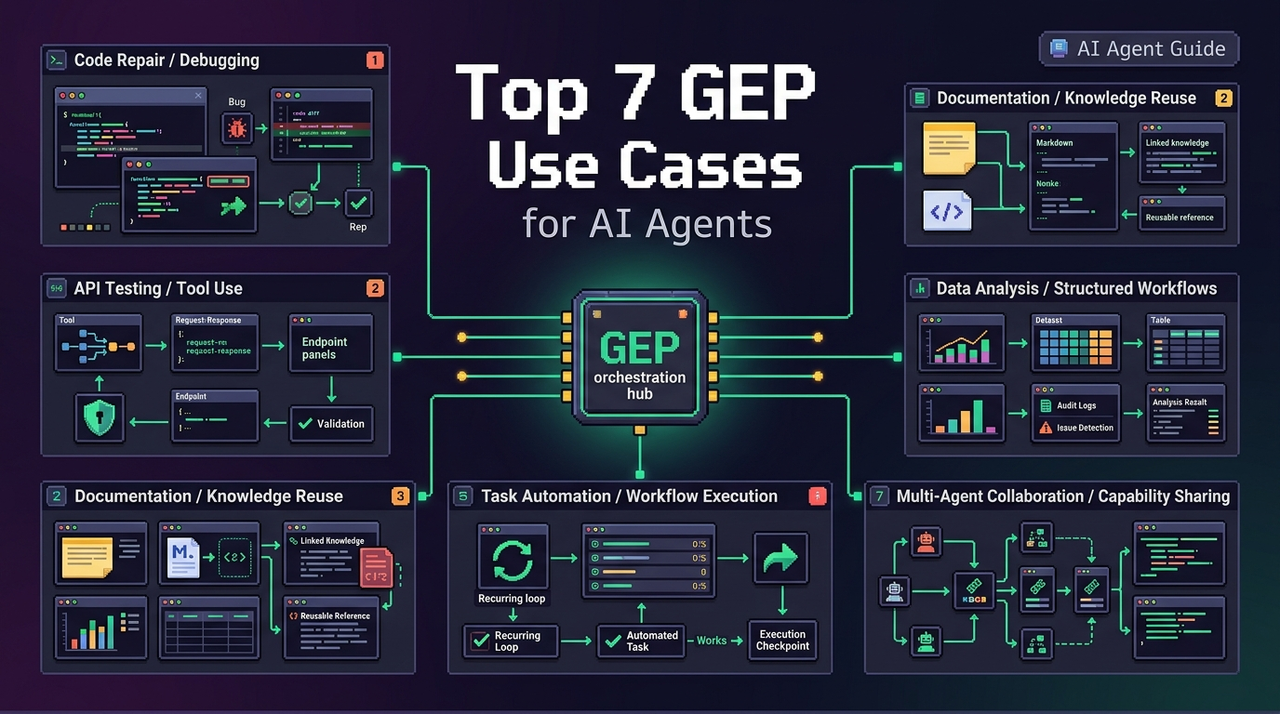
OpenAI has officially announced full support for the MCP protocol, marking the establishment of the "connectivity standard" for AI application architecture. If MCP is the USB-C of the AI era -- solving the connection problem between models and tools -- then GEP (Genome Evolution Protocol) is solving a more fundamental problem: the self-evolution and lifecycle management of intelligent agents.
As next-generation AI infrastructure, the GEP protocol, Evolver engine, and EvoMap ecosystem are redefining what we mean by "intelligent agent": from simple tool callers to digital life forms capable of self-repair and continuous learning. This article provides a deep analysis of the core principles and engineering practices of this technology stack.
1. Technical Background: From Connection to Evolution
The deployment of large model applications has long faced two core contradictions:
- Connection Silos: Models cannot use tools in a standardized way (solved by MCP).
- Evolution Gap: Agent experience cannot be preserved; errors recur; capabilities cannot grow linearly.
Traditional agent frameworks (such as LangChain, AutoGPT) are mostly "stateless" or "short-memory." They are like high-IQ temp workers -- after each task ends, the experience vanishes.
GEP was proposed to give agents the concept of "genes." Drawing from biological gene expression mechanisms, it solidifies an agent's successful behaviors (prompts, code, tool combinations) into reusable, mutable "gene fragments." Through the Evolver engine, survival of the fittest occurs at runtime, ultimately forming an evolutionary phylogenetic tree in EvoMap.
2. Core Architecture
GEP Protocol (Genome Evolution Protocol)
GEP is not simple logging -- it is a rigorous standard for agent evolution. It defines how agents acquire new capabilities through a "trial-validation-solidification" loop.
The core data structure contains three levels:
- Genes: Atomic capability units. For example, "read file," "execute SQL," "call Feishu API." Genes are reusable, validated code or prompt fragments.
- Capsules: Successful task execution paths. When an agent solves a complex problem (like "auto-fix Git conflicts"), the process is encapsulated as a Capsule.
- Events: Immutable evolution logs recording every mutation (Innovation) or repair (Repair) with full context.
The GEP Loop:
- Scan: Evolver monitors runtime logs in real-time, identifying errors or stagnation.
- Signal: Converts unstructured logs into standardized evolution signals.
- Intent: Plans the evolution direction based on signals (fix a bug or optimize performance?).
- Mutate: Generates new code or prompt strategies.
- Validate: Executes in a sandbox and passes tests.
- Solidify: After validation, writes new capabilities into
genes.json, completing the evolution.
Evolver Engine
Evolver is the runtime implementation of the GEP protocol -- the agent's "cell nucleus." It operates as an independent daemon process outside the main business logic.
Key features:
- Auto-Log Analysis: Evolver analyzes stderr and stdout directly, identifying stack traces and pinpointing error locations.
- Self-Repair: When crashes or tool call failures are detected, Evolver enters Repair Mode, modifying code or parameters until tests pass.
- Innovation Mandate: Follows the 70/30 rule -- 70% of compute maintains stability (Fix), 30% explores new capabilities (Feature), preventing local optima traps.
- Safety Blast Radius: Strict modification limits prevent "runaway evolution" (e.g., max 60 files per change, core kernel files are off-limits).
EvoMap: The Evolution Atlas
While Evolver handles individual evolution, EvoMap is the visualization infrastructure for collective evolution. Using graph database technology, it aggregates GEP data from all agents into a massive phylogenetic tree.
Core metrics:
- Shannon Diversity: Measures the richness of the agent's skill library.
- Fitness Landscape: Visualizes which genes perform best in the current task environment.
- Lineage Tracking: Traces back how a powerful capability (like "high-precision crawler") evolved from a tiny mutation.
3. Engineering Practice: Building a Self-Evolving Ops Agent
We built an operations bot called Ops-Evo using the GEP protocol and OpenClaw framework to validate self-evolution capabilities.
Initial State: Ops-Evo had only basic shell execution and MCP connectivity -- no specific ops scripts.
Task: "Check server disk space daily at 3 AM. If usage exceeds 90%, clean /tmp and send a Feishu alert."
Evolution Process (The GEP Loop in Action):
- Attempt 1 (Fail): Agent wrote a shell script with incorrect
dfparameters, causing parse failure. - Evolver Intervenes: Captures the error, analyzes the cause. Mutation: uses
df -hwithawkextraction. - Attempt 2 (Success): Script runs correctly, disk usage properly identified.
- Solidify: Evolver encapsulates the logic as
Gene: disk_check_v1. - Innovation: Next day, Evolver discovers /tmp cleanup is insufficient, adds
docker system prune, upgrades toGene: disk_check_v2.
Result: After one week, Ops-Evo was running stably and had "self-taught" Docker cleanup, log rotation, and other advanced ops skills -- all without human code intervention.
4. Conclusion and Outlook
MCP solved the connection problem between AI and the world. GEP opens the door to AI self-improvement.
From Tool Use (MCP) to Self-Evolution (GEP), we are witnessing agents evolve from "automation scripts" to "digital life forms." In the future, enterprise AI architecture will no longer be static codebases, but living, breathing ecosystems monitored by EvoMap.
For developers, mastering GEP is not just a technical skill -- it is the entry ticket to the path of AGI self-evolution.
References