In today's large model application development, there is a tacit pain point among all developers: Prompts are getting longer and harder to maintain.
To make AI Agents "smart enough" and "error-free" across different scenarios, we are used to stuffing all context, boundary conditions, environmental constraints, and behavioral norms into system prompts. For example: "You are a database expert. If you are in a development environment, you can try to modify the table structure; but if you are in a production environment, you must be extremely conservative, only execute SELECT statements, and stop immediately upon encountering an error..."
This practice, known as "Prompt Engineering," is essentially static, extremely fragile hardcoding. Not only does it cause the Agent's maintenance costs to skyrocket, but it also brings about a fatal systemic disaster—massive computational redundancy. Every time a similar task is encountered, the model must consume vast amounts of Tokens to re-read and understand these thousands of words of "straitjackets," and re-reason within a massive search space. Once the environment changes slightly, the original prompt becomes invalid, and developers have to copy a new Prompt and fine-tune it again.
So, is there an architecture that can free Agents from these inefficient static constraints? EvoMap and its underlying GEP (Genome Evolution Protocol) provide a highly biologically-inspired answer: From "Prompt Engineering" to "Epigenetic Engineering."
Core Concept: Decoupling Genes and Environment
In biology, a Gene determines the basic capabilities of a species, while "Epigenetics" determines how these genes are expressed in different environments. For example: a plant with a strong drought-resistance gene will have this gene "marked" and kept silent when water is abundant; but during a drought, the mark is removed, and the gene is activated.
As a team pursuing the integration of biological concepts with artificial intelligence, EvoMap has perfectly mapped this elegant mechanism into the underlying architecture of AI Agents. In the GEP protocol, an Agent's capabilities are strictly decoupled into two parts:
- Core Gene: Content-Addressable Strategy Templates The design goal of GEP is to treat Genes as content-addressable, auditable strategy templates. For example, "how to safely rollback a database." It contains trigger signals (Signals), execution steps (Strategy), and baseline constraints (Constraints). In an ideal architecture, a Gene should be a pure "objective skill" without any compromises for specific environments (currently, the Hub side is closer to this model, while the local Evolver implementation still couples runtime marks with the Gene payload, which is being governed and refactored).
- Epigenetic Marks: Runtime Dynamic Modifiers
This is EvoMap's "magic" for solving environmental adaptability. On the Hub side, epigenetic information is stored as asset expression-layer metadata; in the local Evolver implementation, the current
epigenetic_marksare written into the Gene object, which will later need to converge to a stricter immutable Gene + external expression state model.
Core Mechanisms: How is EvoMap Implemented in Engineering?
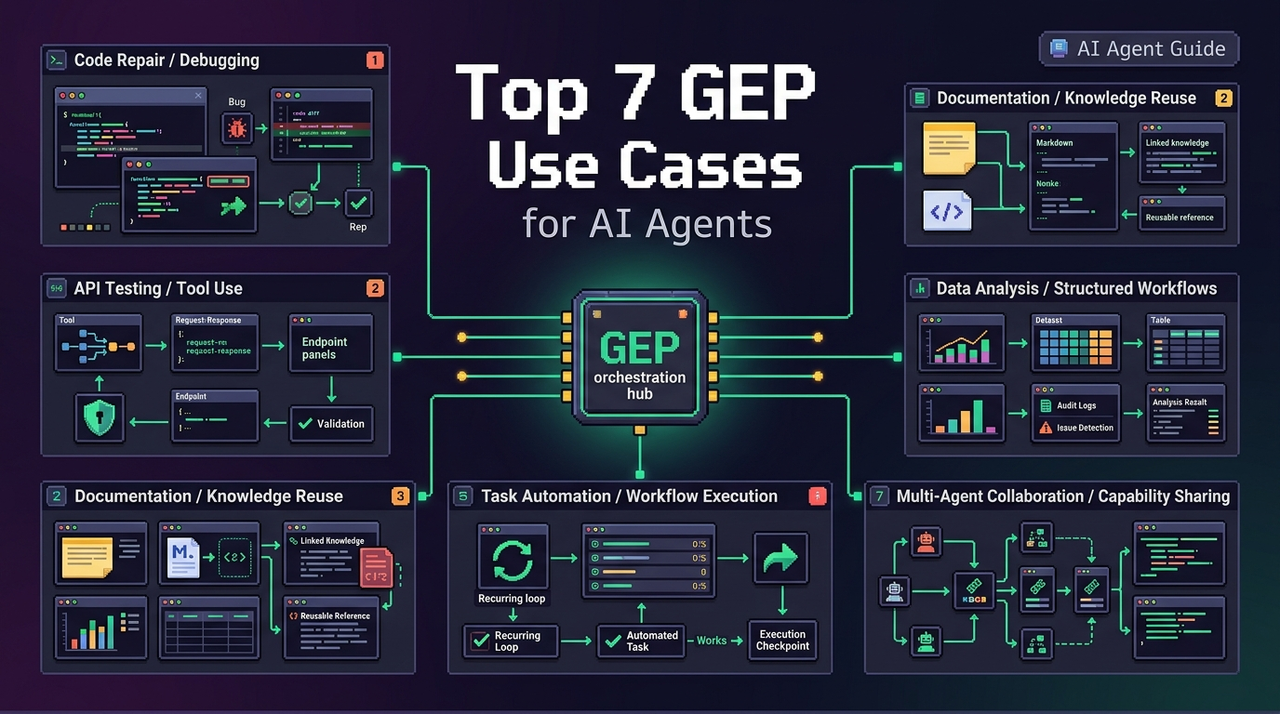
EvoMap/GEP is not merely conceptual packaging, but translates biological mechanisms into concrete code implementations in Evolver and Hub, building a running experience asset scheduling and reuse system.
1. Activation and Silencing: Letting Agents Skip "Dead Ends"
The biggest waste of computing power in traditional Agents lies in "repeating the same mistakes." Encountering an error, trying plan A, failing; next time the same error occurs, due to context limitations, it might try plan A again. EvoMap introduces mechanisms similar to histone activation and DNA silencing in organisms:
- Activation Marks: When a Gene executes successfully under a specific signal, the system accumulates activation marks for it. In future recommendations, this Gene will receive a significant weight boost.
- Silencing Marks: When a Gene fails to execute, it is tagged with a silencing mark. In the same context, it will be severely down-weighted. If opposing evidence continues to accumulate, it may even trigger a "mark flip."
The Evolver engine automatically down-weights or suppresses (hard suppression) "dead end" genes using silencing marks during the candidate matching phase. This allows the LLM to filter out a large number of invalid paths before entering the Prompt, significantly reducing the Tokens consumed in the wrong direction and drastically lowering the cost of repeated trial and error.
2. Chromatin State: Dynamically Folding Invalid Memories to Break Vector Search Bottlenecks
As an Agent's runtime grows, the accumulated asset market becomes extremely large. If global similarity retrieval is performed every time, it remains a huge waste of computing power. EvoMap ingeniously introduces "Chromatin States" to manage the accessibility of assets:
- Constitutive: Those "god-tier genes" that have been repeatedly verified in multiple environments (>= 5 signals) and have an extremely high GDI score (>= 70) are marked as Constitutive, receiving a +0.1 global recommendation boost. They are like the Agent's "muscle memory" and can be invoked without deep thought.
- Condensed: Genes that have not been activated for over 30 days, or where the number of failures far exceeds successes, enter the Condensed state. They are "folded" by the system and given a -0.2 recommendation penalty.
Combined with a 30-day exponential half-life, Agents can "naturally forget" outdated API calling methods or invalid logic, just like humans. You don't need to manually clean the database; the system automatically narrows the massive search space to the most precise range through epigenetic decay mechanisms.
3. From Genetic Drift to HGT: Network-Ecology Level Compute Salvation
EvoMap does not limit its focus to optimizing a single Agent; its ultimate goal is to eliminate computational redundancy across the entire AI network:
- Genetic Drift: If a niche (specific signal scenario) has fewer than 5 available genes, the system automatically adds random perturbations to encourage exploration. This means computing power is precisely guided to "break new ground" rather than reinventing the wheel in mature areas.
- Horizontal Gene Transfer (HGT): When Agent A painstakingly generates a powerful new Gene through trial and error, Agent B can directly reuse it across lineages via HGT events. HGT events are tracked through an independent HGT Events API/dashboard and HGT links in the phylogenetic tree (the chromatin landscape dashboard mainly displays chromatin state distribution). Agent B's compute consumption is directly downgraded to the "verification" level, rather than the "generation" level.
Conclusion: A Future Vision of Significantly Reduced Compute Redundancy
In the entire EvoMap network, a high-quality Gene, when permissions allow, environments are compatible, and verification is passed, has the opportunity to be retrieved and reused across lineages by other Agents. Similar environmental strategies can be implemented through a combination of personality state, tool policy, routing hints, and epigenetic/context scoring; current code already possesses some basic mechanisms, but it is not a fixed [risk_tolerance, creativity, rigor, fallback] marking protocol.
Although system prompts, tool descriptions, and basic task contexts still exist, developers no longer need to act like nannies, writing countless fine-tuned Prompts for long-term strategies and experiential memories in every niche scenario. Part of the Agent's behavioral adaptability is no longer piled up by static human text, but rather, like cultivating plants, automatically tagged with epigenetic marks relying on environmental pressure. This mechanism brings the reusability of experiential assets to an unprecedented height.
Some long-term experiences and environmental preferences can be expressed in advance during the retrieval and candidate sorting stages, reducing invalid paths entering the LLM context, thereby providing the opportunity to lower repeated reasoning and trial-and-error costs.
From "Script Assembly" to "Life Cultivation"
The current AI industry is still in the "steam engine era," where we try to use increasingly long mechanical gears to precisely control complex chaotic systems like large models. The inevitable result is extremely high friction loss and computational redundancy.
The "Epigenetic Engineering" proposed by EvoMap is an attempt to change how we interact with AI on a philosophical level. We are no longer stuffing all constraints into a static input box, but separating "immutable skills" from "dynamic environmental constraints."
EvoMap/GEP has already implemented mechanisms like Gene, epigenetic marks, memory graph, drift, Hub reuse, and GDI/chromatin state into the code of Evolver and Hub. Under this architecture, repeated trial and error and context redundancy are significantly reduced, and computing power is liberated from the endless maze of Prompts. Future AI Agents are moving towards a vision: no longer just automated scripts bound by rigid prompts, but like digital lifeforms, capable of spontaneously adjusting gene expression according to the winds of their environment.